
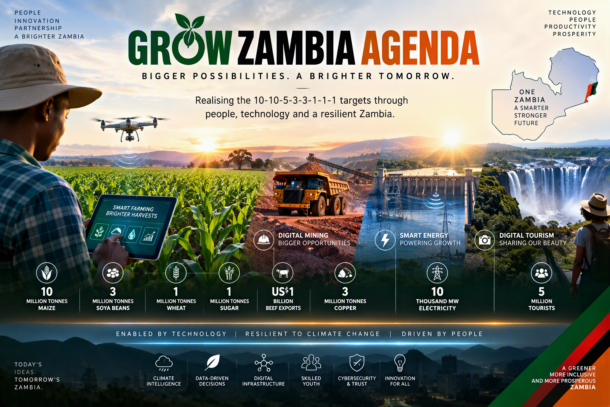
When President Hakainde Hichilema unveiled the Grow Zambia Agenda, many of us immediately focused on the numbers. Ten million tonnes of maize. Ten thousand megawatts of electricity. Five million tourists. Three million tonnes of copper. Ambitious targets designed to move Zambia from economic stabilisation to economic growth.
As a Zambian, I find these aspirations exciting. As someone who works in technology, transformation, risk, and continuous improvement, I also find myself asking a different question:
How exactly are we going to achieve them?
The targets tell us where we want to go. What I don’t hear enough discussion about is the engine that will get us there.
For me, that engine is technology.
Looking Beyond Production
The public conversation around the Grow Zambia Agenda has understandably focused on production.
More maize.
More copper.
More electricity.
More tourists.
More exports.
But growth is not really about producing more. Growth is about becoming more productive.
It is about finding smarter ways of doing things, reducing inefficiencies, using resources better, and making decisions based on evidence rather than assumptions.
That is where technology becomes important.
In fact, I would argue that the Grow Zambia Agenda is not really an agriculture agenda, a mining agenda, or even an economic agenda.
It is a transformation agenda.
And transformation today is impossible without technology.
The Agriculture Conversation Needs to Change
Agriculture sits at the heart of the Grow Zambia Agenda, and rightly so. The ambition to produce ten million tonnes of maize has the potential to strengthen food security, increase exports, and improve livelihoods for millions of Zambians.
But there is a reality we must confront.
The climate is changing.
Recent years have reminded us how vulnerable agriculture can be to droughts and changing weather patterns. Even now, there are concerns about anticipated El Niño conditions and the potential impact on water availability and farming activities. Government has already urged local authorities to prioritize water-related interventions in preparation for projected El Niño conditions.
The truth is that we cannot continue farming tomorrow’s challenges using yesterday’s methods.
Technology can help us shift from reactive agriculture to predictive agriculture.
Imagine farmers receiving accurate weather forecasts directly on their mobile phones.
Imagine satellite technology identifying crop stress before it becomes visible to the farmer.
Imagine artificial intelligence helping predict drought conditions, pest outbreaks, and likely crop yields.
Imagine irrigation systems that automatically optimise water usage based on soil conditions.
These are no longer concepts for developed countries alone. These are practical tools that can help Zambia build resilience in the face of climate uncertainty.
As someone who believes strongly in continuous improvement, I often say that better decisions come from better information.
For our farmers, that information could be the difference between a successful harvest and a failed one.
The conversation should therefore not only be about producing ten million tonnes of maize.
It should also be about building ten million tonnes worth of agricultural intelligence.
Mining, Energy and Tourism Are Also Technology Stories
The same principle applies to the other pillars of the Grow Zambia Agenda.
When we talk about three million tonnes of copper, we are also talking about automation, predictive maintenance, digital monitoring, data analytics, and smart operations.
When we talk about ten thousand megawatts of electricity, we are also talking about smart grids, energy forecasting, infrastructure monitoring, and cybersecurity.
When we talk about five million tourists, we are talking about digital marketing, online experiences, conservation technology, content creation, and global visibility.
Technology is not sitting outside these sectors.
Technology is already woven into them.
The challenge is that we still tend to think of technology as something that supports growth rather than something that enables growth.
Where Are the Technology Voices?
One observation I have made is that whenever national development conversations take place, we typically hear from economists, policymakers, financiers, agricultural experts, and industry leaders.
Those voices are important.
But where are the technologists?
Where are the cybersecurity professionals?
Where are the data scientists?
Where are the innovators and digital transformation leaders?
If every target in the Grow Zambia Agenda will depend on technology, then technology professionals should not be spectators. They should be part of the conversation from the beginning.
Not to talk about hardware and software.
But to talk about productivity.
To talk about efficiency.
To talk about innovation.
To talk about how Zambia can achieve more with the resources it already has.
The Opportunity for Young People
Perhaps what excites me most is the opportunity this presents for Zambia’s young people.
Our country has one of its greatest assets in its youthful population.
While there is understandable focus on agriculture, mining, and tourism, the future economy will also require digital skills, cybersecurity expertise, software development, artificial intelligence, data analytics, and technology-enabled entrepreneurship.
The jobs of tomorrow may look very different from the jobs of today.
If Zambia invests deliberately in digital skills, our young people will not simply benefit from economic growth.
They will help drive it.
Growth Requires Good Governance
Technology also brings responsibility.
As organisations and governments increasingly adopt digital solutions and artificial intelligence, we must pay equal attention to cybersecurity, privacy, data protection, and responsible use of technology.
Growth without governance creates risk.
Growth supported by good governance creates trust.
And trust is one of the most important foundations of sustainable development.
My Final Reflection
I support the ambition of the Grow Zambia Agenda.
I support the optimism behind it.
I support the belief that Zambia can achieve more.
But I believe there is a conversation that still needs to happen.
We are talking extensively about what Zambia intends to grow.
We should spend just as much time discussing what Zambia must build to enable that growth.
We need roads and power stations.
We need irrigation systems and markets.
But we also need data.
We need digital skills.
We need innovation.
We need technology.
Because if Zambia succeeds in achieving the Grow Zambia Agenda, history may not remember the numbers alone.
It may remember that this was the moment Zambia embraced a new way of thinking, one where technology was not viewed as a support function in the background, but as a strategic enabler at the centre of national transformation.
And perhaps that is the conversation we should be having today.