
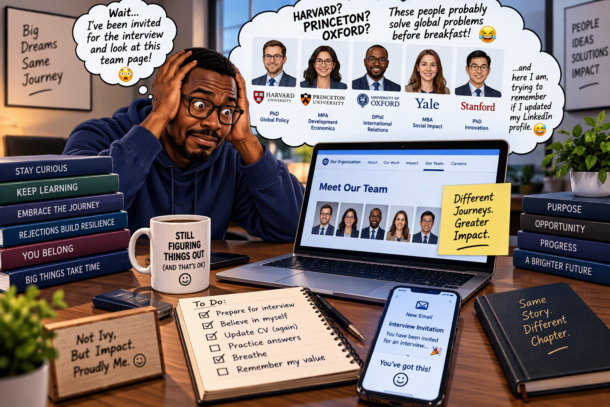
A few months ago, I received an invitation to interview for a Director role with an international non-profit.
Naturally, I was excited.
I celebrated for about seven minutes.
Then I decided to do my homework.
“Let me learn more about the organization,” I told myself, confidently.
So I visited the website.
Mission. Impressive.
Programs. Impressive.
Impact. Very impressive.
Everything was going well.
Then I clicked on the team page.
Friends…
That was a mistake.
The first profile I opened had degrees from institutions I normally only encounter when reading global rankings.
Harvard.
Princeton.
Yale.
Oxford.
Another profile had enough academic achievements to qualify as a small library.
Another seemed to have worked in three continents, advised governments, published papers, and probably solved world hunger during a lunch break.
At this point, my research had taken a dangerous turn.
I was no longer evaluating the organization.
I was evaluating my life choices.
😂
I remember sitting there thinking:
“These people don’t have careers. They have documentaries.”
Then the panic slowly started creeping in.
A little voice in my head asked:
“Miller, what exactly are you bringing to this conversation?”
Another voice followed:
“Are you sure they invited the right person?”
And because imposter syndrome never misses an opportunity to be unhelpful, it immediately started reviewing every questionable decision I had ever made professionally.
Not my successes.
Not the projects delivered.
Not the teams supported.
Not the years of experience.
No.
It decided this was the perfect moment to remember that presentation I fumbled six years ago.
The Part I Conveniently Forgot
The amazing thing is that while I was busy panicking, I completely ignored one important fact:
They had already invited me.
Nobody accidentally sends a Director-level interview invitation.
Somebody had reviewed my application.
Somebody had looked at my experience.
Somebody had studied my background.
Somebody had decided:
“Let’s have a conversation with this person.”
Yet there I was behaving like I had somehow snuck into the shortlist undetected.
As if security would soon burst into the room and escort me out.
We Do This More Than We Realize
Looking back, I think many professionals do this.
We compare our entire journey to somebody else’s biography.
We focus on what others have that we don’t.
Their schools.
Their titles.
Their credentials.
Their achievements.
Meanwhile, we completely overlook our own story.
I didn’t go to Harvard.
I didn’t go to Princeton.
But I have spent years solving problems, leading teams, implementing change, making mistakes, learning lessons, getting rejected, trying again, and growing through experience.
And that counts too.
The Lesson
The interview taught me something long before the panel asked the first question.
Sometimes we spend so much time wondering whether we belong in the room that we forget we’ve already been invited into it.
The invitation itself is evidence.
Evidence that somebody sees value in your experience.
Evidence that somebody believes you have something worth contributing.
Evidence that you belong in the conversation.
And perhaps that’s the thing imposter syndrome fears most:
Facts.
😄
Because once the panic settled and common sense returned, I realized something.
The panel wasn’t interviewing universities.
The panel wasn’t interviewing logos.
The panel wasn’t interviewing academic institutions.
They were interviewing people.
And for whatever reason, they wanted to interview me too.
Not bad for a guy who was five minutes away from disqualifying himself on behalf of the recruitment team.
Sometimes the biggest obstacle to our next opportunity isn’t the competition.
It’s the story we’re telling ourselves.