
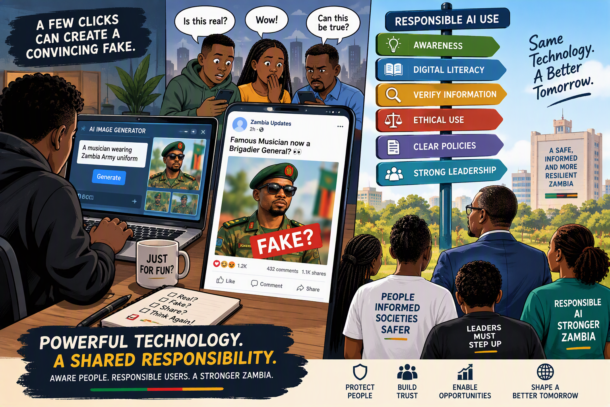
Like many Zambians, I recently followed the reports concerning the alleged AI-generated image depicting a musician wearing a Zambia Army uniform.
The public discussion that followed was predictable.
Many people focused on whether a crime had been committed.
Others debated the potential consequences for those involved.
While those discussions have their place, I found myself thinking about something entirely different.
How many people actually understand what today’s AI tools are capable of?
Because if we are honest, the issue before us is much bigger than a single image.
It is bigger than a single individual.
It is bigger than a single incident.
The real issue is that society is entering a new era of technology faster than many people realize.
We Have Crossed a Technological Threshold
There was a time when creating a realistic image required significant technical expertise.
Today, anyone with a smartphone and an internet connection can generate content that appears remarkably real.
Images.
Videos.
Voice recordings.
Entire conversations.
And the technology is improving every day.
The challenge is that public awareness has not kept pace with technological advancement.
Many people still assume that an image must be real simply because it looks real.
Many organizations still assume that visual evidence can be trusted without verification.
Many leaders have not yet appreciated how quickly AI-generated content can influence public perception.
That is why I believe awareness must become our first line of defence.
The Answer Is Not Panic
Whenever a new technology emerges, society tends to move between two extremes.
On one side, there is excitement.
On the other, there is fear.
Neither is particularly helpful.
Artificial Intelligence is one of the most powerful tools developed in modern times.
It has the potential to improve healthcare, education, agriculture, business, governance, and development outcomes.
I see enormous opportunities for AI within the non-profit sector, particularly in helping organizations analyse data, improve operational efficiency, enhance decision-making, and ultimately serve communities more effectively.
The answer is not to fear AI.
The answer is to understand it.
And understanding begins with awareness.
We Need Responsible Users, Not Just Regulations
As someone who works in risk, compliance, governance, and technology, I have learned that policies alone rarely solve problems.
People do.
Good governance starts with informed people making responsible decisions.
The same principle applies to AI.
Before creating or sharing AI-generated content, people should understand the potential consequences.
Questions such as:
- Could this mislead others?
- Could this damage somebody’s reputation?
- Could this undermine confidence in an institution?
- Could this create confusion?
- Could this contribute to misinformation?
These are questions every responsible AI user should be asking.
Not because the law requires it.
But because responsible citizenship requires it.
This Is Where Leaders Must Step Up
Perhaps the biggest lesson I take from this incident is that leaders can no longer afford to be passive observers of technological change.
Whether you are a CEO, Board member, Government official, NGO leader, school administrator, church leader, or parent, AI is now part of the environment in which decisions are being made.
Leadership in the AI era cannot simply be about reacting when incidents occur.
It must be about preparing people before incidents occur.
Leaders should be asking:
- Do our teams understand AI?
- Have we discussed responsible use?
- Have we explained the risks?
- Have we established clear expectations?
- Are we helping people distinguish between innovation and misuse?
Awareness does not happen by accident.
It requires deliberate leadership.
AI Governance Is an Education Challenge
When people hear the term AI governance, they often imagine complex frameworks, regulations, and technical standards.
Those things matter.
But governance also involves education.
In many cases, the most effective control is not a policy.
It is an informed individual who understands the risks and decides to act responsibly.
The organizations that will navigate AI successfully will not necessarily be those with the most sophisticated technology.
They will be those that invest in awareness, digital literacy, and responsible use.
The Opportunity Before Us
I believe Zambia, like many countries, has an opportunity to get ahead of this challenge.
Rather than waiting for incidents to multiply, we can begin having meaningful conversations about:
- Responsible AI use
- Digital literacy
- Verification of information
- Ethical content creation
- AI governance
- Online accountability
These conversations should not be limited to technology professionals.
They should happen in schools, workplaces, boardrooms, universities, community organizations, and homes.
Because AI is no longer a specialist topic.
It is becoming an everyday reality.
My Thoughts
When I look at the Zambia Army AI image incident, I do not primarily see a technology problem.
I see an awareness challenge.
A reminder that our understanding of AI must evolve as rapidly as the technology itself.
Yes, there will always be discussions around accountability and legal consequences.
But if our response begins and ends there, we will miss the bigger opportunity.
The opportunity is to educate.
To create awareness.
To build digital responsibility.
And to help people understand that with powerful technology comes an equally important responsibility to use it wisely.
Because the future of AI will not be determined by the technology alone.
It will be determined by the choices people make when they use it.
And that is where leadership matters most.