
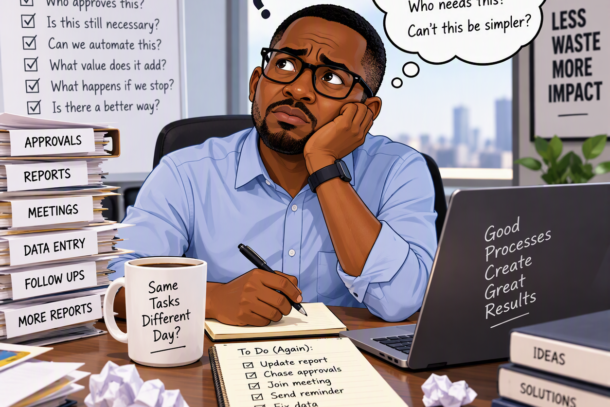
One of my favourite observations from years of working in transformation, technology, operations, and continuous improvement is this:
Most organizations don’t have a productivity problem. They have a complexity problem.
And the interesting thing about complexity is that nobody intentionally creates it.
It just sort of… accumulates.
Like unread emails.
Or WhatsApp groups.
Or that one spreadsheet with seventeen tabs that nobody understands, yet somehow it has become more protected than the national treasury.
Waste Rarely Looks Like Waste
When people hear the word waste, they immediately picture something obvious.
Unused materials.
Broken equipment.
Expired stock.
In reality, some of the biggest waste in organizations is disguised as work.
The report that gets produced every month because it has always been produced every month.
The meeting that takes an hour to decide what should be discussed in the next meeting.
The approval process that requires four signatures from people who openly admit they don’t know why they’re signing.
The spreadsheet exported from one system, edited manually, and imported back into another system so it can eventually be copied into PowerPoint.
We’ve become so familiar with these things that we no longer see them as waste.
We call them “process.”
The Most Expensive Words in Business
If I could ban one phrase from organizational vocabulary, it would be:
“We’ve always done it this way.”
Those six words have probably killed more improvement ideas than budget cuts ever have.
What fascinates me is that when you start asking questions, nobody can actually explain why some activities still exist.
At some point years ago, a problem emerged.
A process was created.
The problem disappeared.
The process remained.
Then somebody added another step.
Then another approval.
Then another report.
Before long, what was originally a simple process now looks like the application process for a mortgage, a passport, and a UN grant rolled into one.
And nobody remembers how it got there.
We Underestimate the Cost of Small Inefficiencies
Most organizations are very good at identifying a K100,000 cost.
They’re far less effective at identifying a ten-minute waste.
Yet ten minutes repeated 100 times becomes a much bigger problem.
A team spends ten minutes searching for information.
Another ten waiting for approval.
Another ten duplicating data entry.
Another ten correcting preventable errors.
By the end of the year, hundreds of productive hours have quietly disappeared.
Not because people weren’t working hard.
But because the process was working against them.
In fact, some employees spend so much time navigating the process that if efficiency were measured in approvals obtained per day, they would qualify for Olympic selection.
Technology Doesn’t Magically Fix Bad Processes
As somebody from a technology background, let me say something that software vendors may not appreciate:
Not every problem needs a new system.
Sometimes what you actually need is fewer steps.
I’ve seen organizations automate inefficient processes and celebrate the outcome.
The waste didn’t disappear.
It just became electronic.
A bad process running at high speed is still a bad process.
That’s a little like buying a faster vehicle for a road that doesn’t go anywhere.
You’ll arrive nowhere much quicker.
Before introducing technology, the better questions are:
- Why does this process exist?
- What value does it create?
- Which steps can be eliminated?
- Which approvals are actually necessary?
Only after simplifying the work should we look at automating it.
Otherwise we’re simply putting a faster engine into a traffic jam.
Meetings Need Their Own Waste Category
Let’s talk about meetings.
Not all meetings are waste.
Many are essential.
But we’ve all attended those meetings where fifty minutes are spent discussing a problem and the final ten minutes are spent agreeing to discuss it again next week.
Some meetings have no agenda.
Some have no decisions.
Some have no clear purpose.
And occasionally, if we’re truly blessed, they have all three.
I’ve attended meetings where the most productive outcome was agreeing to send another email.
I’ve also attended meetings where the phrase:
“Let’s take this offline”
appeared so many times that I wondered whether the entire meeting should have started offline in the first place.
One of my favourite continuous improvement questions is:
“If this meeting were cancelled, what would happen?”
The answer is often revealing.
Sometimes the most productive meeting is the one that never takes place.
Continuous Improvement Is Not Glamorous
People often assume continuous improvement is about large transformation programmes, consultants with colourful diagrams, and workshops involving enough sticky notes to solve climate change.
In reality, it is usually much simpler.
A form that is shortened.
A report that is retired.
A duplicate approval that is removed.
A manual task that is automated.
A bottleneck that is eliminated.
The best improvements are often so simple that people wonder why they didn’t make the change years ago.
Usually right after spending three years complaining about it.
The Question I Ask Most Often
Whenever I work with teams, there is one question that consistently uncovers opportunities:
“What makes your job harder than it needs to be?”
The answers come quickly.
Because people know.
They live with the frustrations every day.
The challenge is not finding the waste.
The challenge is giving people permission to challenge it.
Often, the person closest to the work has identified the solution months ago.
They’re simply waiting for an opportunity to be heard, or perhaps waiting for approval to request permission to propose the improvement.