
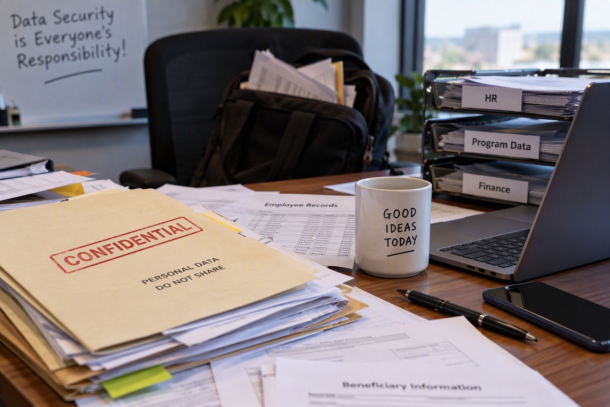
When I first became involved in Data Protection Impact Assessments (DPIAs), I approached them like many people do, as a compliance requirement.
A document.
A process.
A checklist.
A regulatory expectation.
What I have learned through experience is that a good DPIA is far more than that.
In fact, one of the biggest surprises for me has been that the greatest value of a DPIA is often not the privacy risks it identifies. It is the conversations it creates and the insights it reveals about how an organization actually works.
The Moment Organizations Discover Themselves
Most organizations believe they understand how data flows through their operations.
Then a DPIA starts.
During interviews and workshops, you begin speaking with different departments, reviewing forms, examining systems, tracing information flows, and asking seemingly simple questions:
- Why do you collect this information?
- Who has access to it?
- Where is it stored?
- How long do you keep it?
- Who do you share it with?
- What happens if something goes wrong?
Suddenly, things become very interesting.
You discover processes that evolved over time but were never formally documented.
You find spreadsheets being used alongside enterprise systems.
You uncover duplicate data collection.
You identify activities that made sense years ago but no longer serve a purpose.
Most importantly, you begin to see the organization through the lens of information rather than departments.
That perspective is incredibly powerful.
A DPIA Is Really A Process Improvement Exercise
As someone with a background in continuous improvement and transformation, I have come to view DPIAs as much more than a privacy tool.
At their core, they are a process improvement exercise.
To assess privacy risk, you first have to understand the process.
You have to map it.
Question it.
Challenge assumptions.
Identify inefficiencies.
Understand decision points.
Determine whether each piece of information being collected is actually necessary.
Many organizations start a DPIA believing they are reviewing data protection. By the end, they are redesigning workflows, eliminating unnecessary activities, improving accountability, and creating better governance mechanisms.
Privacy becomes the catalyst for broader organizational improvement.
Data Governance Is About More Than Technology
One of the most common misconceptions I encounter is the belief that data governance is primarily an IT responsibility.
It is not.
Technology plays an important role, but governance begins long before the technology.
Governance is about decisions.
Who decides what data is collected?
Who decides why it is collected?
Who approves access?
Who determines retention periods?
Who is accountable for quality and accuracy?
Who ensures that information is only used for legitimate purposes?
A DPIA forces organizations to confront these questions.
In many cases, the technical controls already exist. The real gap lies in ownership, accountability, and decision-making.
That is a governance issue, not a technology issue.
The Human Side of Privacy
One thing I particularly appreciate about DPIAs is that they bring the focus back to people.
We often talk about databases, applications, servers, cloud platforms, and systems.
But behind every record is a human being.
A child.
A parent.
An employee.
A donor.
A community member.
Privacy discussions become much more meaningful when we stop talking about data and start talking about people.
The question shifts from:
“How do we protect this information?”
to
“How do we protect the person behind the information?”
That shift changes the quality of decisions organizations make.
Privacy By Design Is Good Governance
The best organizations do not treat privacy as something to consider after implementation.
They build it into the design.
They ask important questions before launching new initiatives.
They challenge whether data collection is necessary.
They define clear ownership.
They establish accountability.
They consider risks early.
In my experience, organizations that embrace this mindset tend to perform better in many other areas as well.
They usually have stronger governance.
Better documentation.
Clearer processes.
More disciplined decision-making.
Greater organizational maturity.
Privacy becomes a reflection of how well an organization governs itself.
My Biggest Lesson
If there is one lesson I have learned from leading and participating in DPIAs, it is this:
A DPIA rarely tells you something only about data protection. It tells you something about your organization.
It reveals how decisions are made.
How processes work.
How responsibilities are assigned.
How risks are managed.
And sometimes, how improvement opportunities have been hiding in plain sight.
What starts as a compliance requirement often becomes a valuable exercise in organizational learning and transformation.
Final Reflection
The next time someone describes a DPIA as a privacy document, I would encourage them to think differently.
A well-executed DPIA is a mirror.
It allows an organization to see itself more clearly.
Yes, it helps identify privacy risks.
Yes, it supports regulatory compliance.
But it also helps organizations improve processes, strengthen governance, clarify accountability, and build trust.
And in an increasingly digital world, trust may be one of the most valuable assets an organization can possess.
For me, that is the real power of a DPIA. Not just protecting data, but helping organizations become better stewards of the information, people, and communities they serve.